




Imagine two ecommerce brands.
The first invests $100,000 in Meta and Google Ads.
After accounting for ad spend, fulfillment, and marketing costs, they generate a respectable return. Depending on the business, paid advertising might deliver an ROI of 100–300% (or a 2–4× ROAS)—good enough to keep scaling.
Now look at the second brand.
Instead of putting every dollar into acquiring new customers, they invest in email marketing—welcome flows, abandoned cart recovery, customer segmentation, and post-purchase automation.
The result?
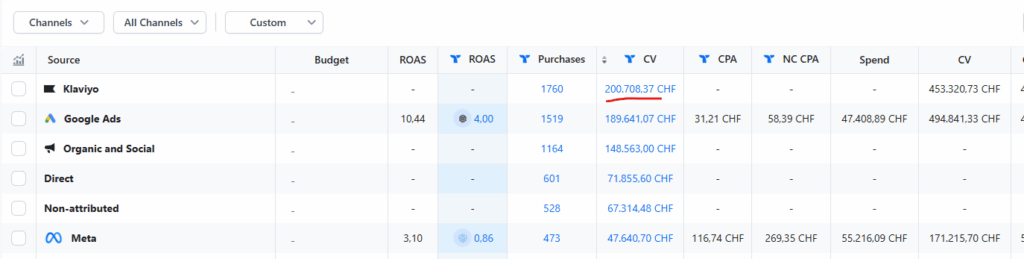
Email marketing generates an average ROI of 3,600% (about $36 for every $1 invested)
One channel pays to find customers.
The other helps you maximize the value of customers you’ve already paid to acquire.
That’s the difference between renting attention…
…and building an asset that keeps generating revenue long after the first purchase.
Here’s what surprises most founders.
Ask them where most of their marketing budget goes, and they’ll point to paid ads without hesitation.
Ask them what percentage of revenue came from email last month…
How much their welcome flow generated…
Or whether their post-purchase emails increased repeat purchases…
Most don’t know. Not because they don’t care. Because email is often treated like a newsletter instead of what it really is:
One of the highest-return marketing channels in ecommerce.
The brands quietly pulling ahead aren’t always spending more on ads.
They’re earning more from every customer they’ve already acquired.
Why Email Marketing ROI Is Higher Than Paid Advertising
The average ecommerce founder doesn’t have a traffic problem.
They have a customer retention problem.
Every month, thousands of dollars go into Meta, Google, TikTok, and influencer campaigns. New customers arrive, orders come in, and the dashboard looks healthy.
Then… nothing. The customer disappears.
No welcome journey. No education. No reason to come back. The brand celebrates the first purchase while ignoring the next five.
That’s where email marketing ROI begins.
Not before the sale.
After it.
The brands growing the fastest aren’t always buying more customers—they’re making every customer worth more. Paid advertising is essential.
Without it, most ecommerce brands would struggle to acquire new customers.
But acquisition alone doesn’t build a profitable business.
Retention does.
That’s why email consistently delivers one of the highest returns in digital marketing.
Paid Ads Capture Attention. Email Builds the Relationship.
Let’s get one thing straight.
Paid advertising isn’t the enemy.
In fact, it’s one of the fastest ways to introduce your brand to new customers. Without Google Ads, Meta, TikTok, or other acquisition channels, most ecommerce businesses would struggle to grow.
But paid ads have one limitation.
The moment you stop investing, the traffic slows down.
Every click has a cost.
Every impression comes with a price tag.
Email works differently.
When someone subscribes to your list or makes their first purchase, you don’t just gain another contact.
You gain permission to keep the conversation going.
That’s where the magic happens.
A welcome flow turns curiosity into trust.
An abandoned cart email recovers lost revenue.
A post-purchase sequence creates loyalty.
A replenishment reminder brings customers back exactly when they need you.
Instead of paying to reach the same customer over and over, you’re building a relationship that compounds over time.
Paid ads open the door. Email keeps customers coming back.
Together, they’re one of the most profitable combinations in ecommerce.
Ads bring people in.
Email increases their lifetime value.
And when customer lifetime value goes up, every advertising dollar becomes more profitable.
That’s why the smartest brands don’t ask,
«Should we invest in ads or email?»
They ask,
«How can email make every ad dollar work harder?»
Email Marketing ROI grows with every purchase
Most founders look at Return on Ad Spend (ROAS).
High-performing brands look at Customer Lifetime Value (CLV).
There’s a big difference.
Ads measure the cost of getting the first sale.
Email measures the value of every sale that comes after.
A welcome flow turns subscribers into buyers.
An abandoned cart flow recovers revenue that would’ve been lost.
A post-purchase sequence creates trust.
A replenishment reminder brings customers back exactly when they need you.
Individually, these emails don’t look revolutionary.
Together, they become one of the most profitable assets in your business.
Customer Lifetime Value Changes Everything
Here’s a simple thought experiment.
Two brands each spend $50 acquiring a customer.
The first customer buys once.
Revenue stops there.
The second customer receives personalized email campaigns over the next twelve months.
They reorder.
They buy complementary products.
They refer a friend.
Suddenly, that same $50 acquisition generates three or four purchases instead of one.
The acquisition cost never changed. The customer lifetime value did.
That’s why brands with strong email marketing can often afford to outbid competitors on paid ads.
Every customer is simply worth more.
And that’s the hidden reason email marketing ROI consistently outperforms almost every other marketing channel.
If email can generate an average 3,600% ROI, the obvious question becomes:
Why aren’t most ecommerce brands seeing those numbers?
The answer usually isn’t the platform.
It’s how the email program is built.
That’s where the biggest revenue opportunities are hiding.
The Biggest Email Marketing ROI Mistake Ecommerce Brands Make
The biggest mistake isn’t sending too few emails.
It’s treating email like a campaign instead of a customer journey.
We’ve seen brands spend $500,000+ a month on paid ads while their email marketing consists of one weekly newsletter and a basic abandoned cart reminder.
Every new customer is expensive to acquire.
Yet once they buy, the conversation ends.
Imagine opening a retail store, greeting every customer at the door, taking their payment…
…and then never speaking to them again.
That’s exactly how many ecommerce brands approach email.
The highest-performing brands think differently.
Every purchase is the beginning of a relationship—not the end of a transaction.
That’s why they invest in automation, personalization, and lifecycle marketing instead of relying solely on discounts.
What Increases Email Marketing ROI?
Increasing email marketing ROI isn’t about sending more emails.
It’s about sending the right message at the right moment.
Welcome Flow
Your welcome flow is your first impression.
A strong welcome series builds trust, tells your story, and converts new subscribers before they forget why they signed up.
Abandoned Cart Emails
Nearly every ecommerce store loses shoppers during checkout.
A well-optimized abandoned cart flow recovers revenue that would otherwise disappear—often becoming one of the highest-converting automations in your account.
Browse Abandonment
Not everyone adds products to their cart.
Browse abandonment emails remind visitors about products they viewed, helping bring back shoppers who weren’t quite ready to buy.
Post-Purchase Emails
The first sale shouldn’t be the last.
Post-purchase emails educate customers, reduce buyer’s remorse, encourage reviews, and naturally introduce complementary products.
Replenishment Reminders
If you sell consumable products, timing matters.
A reminder sent just before customers run out often converts far better than another promotional discount.
Win-Back Campaigns
Some customers simply need a reason to return.
Win-back campaigns reconnect with inactive buyers before they’re lost to competitors.
Customer Segmentation
Not every customer should receive the same email.
Segmenting by purchase history, engagement, location, or behavior makes every campaign more relevant—and relevance is what drives higher email marketing ROI
How to Calculate Email Marketing ROI
Calculating email marketing ROI is surprisingly simple.
Email Marketing ROI = (Revenue − Cost) ÷ Cost × 100
Example
Let’s say your business spends:
- Email marketing cost: $2,000/month
- Revenue generated from email: $74,000/month
Your calculation looks like this:
($74,000 − $2,000) ÷ $2,000 × 100 = 3,600% ROI
In other words…
Every $1 invested returns approximately $36.
That’s why email consistently ranks as one of the highest-return marketing channels available.
Of course, every business is different.
Industry, average order value, customer lifetime value, and retention all influence your results.
Which raises an important question…
How does your email program compare?
Calculate Your Email Marketing ROI
Most ecommerce brands know how much they spend on ads.
Far fewer know how much revenue their email program should be generating.
That’s exactly why we built our Email ROI Calculator.
Instead of relying on averages, our calculator estimates your potential email revenue using metrics like:
- Monthly store revenue
- Email revenue percentage
- Flow performance
- Subscriber list size
- Average order value
- Campaign frequency
In less than two minutes, you’ll discover whether your email channel is performing—or leaving money on the table.
👉 Calculate Your Email Marketing ROI → https://theinvisibleflow.com/email-roi-calculator/
Frequently Asked Questions About Email Marketing ROI
What is a good email marketing ROI?
Industry benchmarks suggest email marketing generates an average 3,600% ROI, or roughly $36 for every $1 invested. High-performing ecommerce brands often exceed this through advanced automation, segmentation, and lifecycle marketing.
Why is email marketing ROI higher than paid advertising?
Paid advertising stops generating results when you stop spending. Email marketing continues generating revenue from customers you’ve already acquired, increasing customer lifetime value through repeat purchases and automated journeys.
How do you calculate email marketing ROI?
Use this formula:
(Revenue Generated − Email Marketing Cost) ÷ Email Marketing Cost × 100
The result shows how much profit your email marketing generates relative to your investment.
What emails generate the highest ROI?
Welcome emails, abandoned cart recovery, browse abandonment, post-purchase automations, replenishment reminders, and win-back campaigns consistently produce some of the highest returns because they’re triggered by customer behavior.
Does email marketing still work in 2026?
Yes. Despite the growth of paid social, AI, and influencer marketing, email remains one of the highest-performing owned channels. It strengthens customer relationships, improves retention, and generates repeat purchases without increasing acquisition costs.
How much revenue should email generate for an ecommerce store?
While every business is different, many healthy ecommerce brands generate 20–40% of total revenue through email marketing. Stores with mature automation and strong customer retention strategies can exceed those benchmarks.
How can I improve my email marketing ROI?
Focus on customer journeys rather than individual campaigns. Optimize welcome flows, abandoned cart recovery, post-purchase sequences, segmentation, personalization, deliverability, and list growth. Small improvements across these areas often compound into significant long-term revenue gains.