



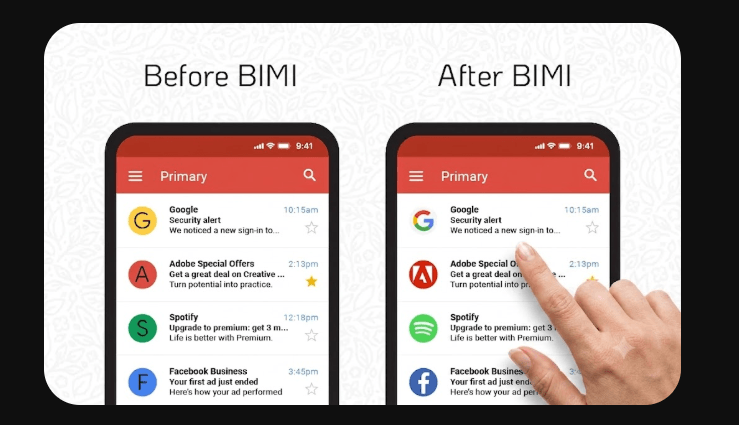
BIMI (Brand Indicators for Message Identification) allows participating mailbox providers to display your company logo next to your emails. To make it work, you’ll need SPF, DKIM, DMARC, a BIMI DNS record and, for providers like Gmail, a Verified Mark Certificate (VMC) or Common Mark Certificate (CMC).
Why isn’t your logo showing in Gmail?
You did everything.
Your emails pass authentication.
DMARC is configured.
Your BIMI record is published.
You even uploaded the perfect SVG logo.
Then… Nothing.
No logo. Just the default sender image.
If this sounds familiar, you’re not alone.
Most businesses assume they’ve configured BIMI incorrectly. Usually, they haven’t.The missing piece is often a BIMI certificate.
What is BIMI?
Imagine walking through a busy shopping street.
You don’t read every shop name. You recognize the logo. That’s exactly what BIMI does.
Instead of showing a generic sender icon, participating mailbox providers display your company logo next to your email.
Before someone even opens your message, they already recognize your brand.
That small visual cue builds trust.
It makes your emails stand out.
And it helps customers know the message really came from you.
How does BIMI work?
BIMI isn’t something you simply switch on.
It’s the final layer of a healthy email authentication setup.
Before your logo can appear, your domain should already have:
✔ SPF
✔ DKIM
✔ DMARC
✔ DMARC set to quarantine or reject
✔ A published BIMI DNS record
✔ An SVG version of your logo
✔ A healthy sender reputation
Think of BIMI as the reward.
Mailbox providers only display your logo when they trust your domain.
Why do you need a BIMI certificate?
This is where most people get confused.
Let’s keep it simple. Imagine someone knocks on your front door.
They say they’re from your bank.
Would you believe them? Probably not.
Now imagine they show official identification.
Immediately you trust them more.
A BIMI certificate works the same way. It tells mailbox providers,
«This logo really belongs to this company.»
Without that verification, anyone could upload the Apple logo.
Or Nike. Or Amazon.
Mailbox providers need proof before displaying a brand’s identity.
What’s the difference between a VMC and a CMC?
There are two certificate types you’ll come across.
1.Verified Mark Certificate (VMC)
A VMC requires your logo to be a registered trademark.
It proves legal ownership of your brand mark. Large enterprises often choose this option because they already own registered trademarks.
Common Mark Certificate (CMC)
A CMC doesn’t require a registered trademark.
Instead, you demonstrate that you’ve consistently used your logo as part of your branding for at least a year. For many growing businesses, this is the easier path.
Both certificates achieve the same goal.
They verify your logo. The only difference is how ownership is proven.
Do you need a BIMI certificate for every domain?
Thankfully…
No.
This is one of the biggest misconceptions around BIMI.
Let’s say your business sends email from:
example.com
newsletter.example.com
receipts.example.com
support.example.com
Many companies assume every domain needs its own certificate.
It doesn’t.
A certificate issued for example.com also covers its subdomains.
Even better…
Many providers support Subject Alternative Names (SANs).
That means one certificate can often protect multiple domains, such as:
example.com
example.co.uk
example.ca
example.com.au
Understanding this before you buy can save hundreds or even thousands of dollars every year.
Why BIMI certificates cost so much
The technology isn’t expensive.
The trust is.
Certificates are issued by organizations known as Mark Verifying Authorities (MVAs).
Their job is to verify your ownership and issue a certificate that mailbox providers trust.
Pricing varies significantly.
Some providers charge per domain.
Others charge for the first domain and offer reduced pricing for additional ones.
Before purchasing, ask:
✔ Does this certificate support SANs?
✔ Does it include subdomains?
✔ What’s the cost for additional domains?
Those three questions alone could save you a substantial amount of money.
Is BIMI worth it?
For businesses sending only occasional emails…
Probably not.
But if email is an important revenue channel, BIMI is becoming increasingly valuable.
Your logo reinforces your brand before the email is opened.
Customers instantly recognize your business.
And mailbox providers increasingly reward domains with strong authentication.
BIMI won’t magically improve deliverability.
But it strengthens trust.
And trust is becoming more important every year.
Before buying a BIMI certificate
Here’s something many providers won’t tell you.
A certificate won’t fix poor email deliverability.
If your sender reputation is weak…
If your authentication isn’t configured correctly…
If your emails already land in spam…
Adding a logo won’t solve those problems.
Think of BIMI as the finishing touch.
Not the foundation.
Test your email deliverability first
Before investing in BIMI, make sure your domain is ready.
Our free Email Deliverability Test checks your authentication setup, including SPF, DKIM, DMARC and other essential records that influence inbox placement.
👉 Run your free Email Deliverability Test
It only takes a couple of minutes and could save you from buying a certificate before your infrastructure is ready.