


Why Giving People a Reason Increases Conversions
The copy machine study revealed a simple lesson: people are more likely to act when they understand why they should. Here is how to apply that principle without sounding pushy or manipulative.
People are more likely to take action when you give them a clear reason. Do not just tell visitors to subscribe, download, or buy. Explain what they receive, why it matters, and what improves after they click.
Do not ask harder. Explain better.
People Are Always Asking, “What’s in It for Me?”
Every person who reaches your website is doing mental math.
They may not say it out loud, but they are thinking:
- What do I get?
- Will this help me?
- How long will it take?
- How much effort will it require?
- What could go wrong?
That is the real decision happening behind every click.
People act when the expected benefit feels greater than the expected cost.
Download the guide.
Download the guide to avoid the five SEO mistakes killing your traffic.
The first version tells people what to do.
The second tells them why doing it will help.
This matters even more in email marketing, where every subject line, link, and call to action competes for attention.
The Famous Copy Machine Study
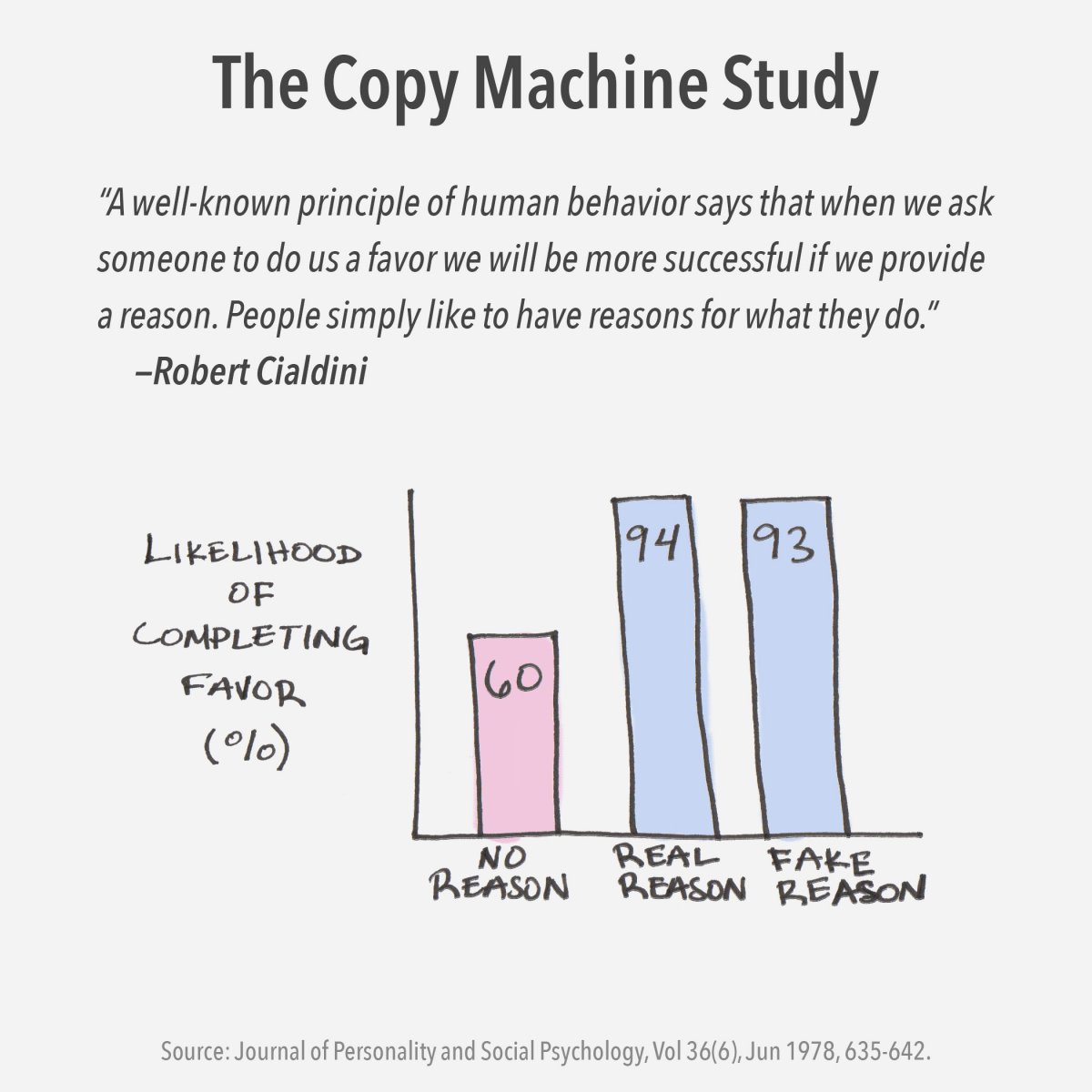
In 1978, psychologists Ellen Langer, Arthur Blank, and Benzion Chanowitz published a study examining how people responded to different ways of asking for a favour.
Researchers approached people waiting to use a photocopier and asked whether they could skip the line.
“Excuse me, I have five pages. May I use the Xerox machine?”
“Excuse me, I have five pages. May I use the Xerox machine because I’m in a rush?”
“Excuse me, I have five pages. May I use the Xerox machine because I have to make copies?”
The final explanation was barely a reason. Everyone in the line needed to make copies.
Yet the presence of an explanation appeared to make the small request easier to accept.
This was a compliance study, not a landing-page conversion test. It does not prove that adding the word “because” will automatically increase sales.
When the request became larger, the meaningless explanation became less persuasive. People paid more attention because saying yes required a greater sacrifice.
Small requests may only need a simple reason. Bigger requests need a stronger reason, more proof, and less perceived risk.
You can read the original research in The Mindlessness of Ostensibly Thoughtful Action .
The Lesson Is Not “Put Because Everywhere”
This is where marketers get lazy.
They hear about the study and think: “I’ll add ‘because’ to my copy and conversions will explode.”
No.
The purpose of the word is to force you to explain the value. The word itself is not magic.
| Weak version | Stronger version |
|---|---|
| Buy now because you should not miss out. | Buy now to lock in the current price before it increases tonight. |
| Subscribe because we send useful emails. | Subscribe to get one practical conversion tactic every Tuesday. |
| Book a demo because our software is powerful. | Book a demo to see how your team can automate weekly reporting in under 15 minutes. |
| Download our guide. | Download the guide to avoid the five mistakes reducing your email revenue. |
The strongest reasons are:
- Specific: they describe a real outcome.
- Relevant: they connect to a problem the reader already cares about.
- Easy to understand: they require no decoding.
- Believable: they avoid unsupported promises.
- Supported by proof: they give the reader a reason to trust the claim.
Vague copy sounds like marketing.
Specific copy sounds like truth.
Stop Writing Calls to Action That Say Nothing
A weak CTA tells people what to do.
A strong CTA tells people:
- What to do
- What they get
- Why it matters
- What happens next
Action + Benefit + Desired Outcome
| Weak CTA | Stronger CTA |
|---|---|
| Subscribe | Subscribe to get one practical growth tactic every week. |
| Download | Download the checklist to launch without missing a step. |
| Start trial | Start your free trial and test every feature before paying. |
| Book a demo | Book a demo to see how much time your team could save. |
| Buy now | Buy now to lock in the discounted price before midnight. |
| Join now | Join now to get the training and templates instantly. |
Clear button labels reduce uncertainty by helping users understand what will happen next. Baymard Institute provides additional guidance on effective button design .
Use “because” as a drafting tool
Before publishing a call to action, complete this sentence:
Do [action] because [reason].
You do not need to keep the word “because” in the final sentence. Use it to find the benefit. Then tighten the copy.
Start your trial because you can test every feature before paying.
Start your free trial and test every feature before you pay.
Sell the Outcome, Not the Action
Nobody wants to download a PDF.
They want the information inside it.
Nobody wants to book a demo.
They want to solve the problem the software claims to fix.
Nobody wants another newsletter.
They want the ideas, savings, opportunities, or results the newsletter promises.
The action is the cost. The outcome is the reward.
Your copy needs to make the reward feel bigger than the cost.
Download our meal plan.
Download the meal plan to know exactly what to eat for the next seven days.
Schedule a consultation.
Schedule a consultation to identify the three biggest opportunities to reduce your costs.
Get the report.
Get the report to see which channels produced your highest return this quarter.
Request an audit.
Request your audit to find the biggest revenue leaks in your retention system.
The more clearly people can picture the outcome, the easier the decision becomes.
This is one reason retention marketing can produce disproportionate returns. It connects relevant messages to outcomes customers already want. Read our breakdown of email marketing ROI and owned-channel growth .
Reasons Work Better When You Add Proof
A reason tells people why they should act.
Proof tells them why they should believe you.
Our email flows increase revenue.
Build your email flows to recover abandoned carts and generate repeat purchases automatically.
Build your email flows to recover carts and increase repeat purchases. See how Memoky generated more than $150,000 in attributed revenue during the first month of its new retention system.
It gives the reader an action, a benefit, a mechanism, and evidence.
See the complete numbers in our Memoky email marketing case study .
Why “How To” Headlines Still Work
“How to” headlines work because they make a clear promise.
They tell the reader: You have a problem. This content will help you solve it.
- How to Write Emails People Read
- How to Improve SEO Without Publishing More Content
- How to Build a Landing Page That Converts
- How to Increase Website Traffic Without Increasing Ad Spend
- How to Write Calls to Action People Click
There is nothing clever about these headlines.
That is why they work.
Clarity beats cleverness.
Compare “Email authentication explained” with How to Show Your Logo in Gmail .
The second headline makes the practical outcome obvious.
List-based headlines can do the same. Our guide to 101 email subject-line ideas leads with the quantity, topic, and desired result.
Google does not reward a page merely because the title begins with “how to.” Its guidance recommends creating helpful, reliable, people-first content .
The headline can win the click.
The content must earn the trust.
The Headline Makes the Promise. The Content Pays the Debt.
Getting attention is easy when you make big promises.
Keeping trust is harder.
Suppose your headline says: “How to Double Your Email Sales in 30 Days.”
Your article now needs to explain:
- What the reader should change
- Why those changes matter
- How to implement them
- What numbers to track
- What could prevent the strategy from working
If the content only gives generic advice, you borrowed attention with the headline and failed to repay it.
The same rule applies to lead magnets, product pages, and calls to action.
If you promise a template that saves three hours, it should save three hours. If you promise a practical guide, do not deliver 40 pages of generic theory.
Strong marketing makes promises.
Strong businesses keep them.
Where to Use This Technique
Start today.
Start today to build your first automated campaign before the weekend.
Read the article.
Read the article to find the three checkout leaks costing you sales.
Join our newsletter.
Join marketers receiving one tested growth tactic every Tuesday.
Add to cart.
Add to cart today to receive free delivery by Friday.
Learn more.
See how the system turns one customer interview into 30 pieces of content.
Book a demo.
Book a 20-minute demo to see how much manual work your team can remove.
Do Not Confuse Persuasion With Manipulation
Giving people a reason is not permission to invent one.
Fake urgency, exaggerated benefits, and unsupported claims may generate clicks in the short term.
They also destroy trust.
- Do not say “Only three left” when you have unlimited stock.
- Do not promise to double revenue with five generic tips.
- Do not advertise a strategy call when it is only a disguised sales pitch.
The reason must be true.
The experience after the click must match the promise before it.
Trust matters especially in email. Better copy cannot compensate for damaged sender trust or poor inbox placement. Learn why delivery rate does not always mean inbox placement in our guide to DKIM2 and email deliverability .
Five Questions to Ask Before Publishing a CTA
Pre-publish checklist
-
Is the action clear?
Can people immediately understand what you want them to do? -
Is the benefit clear?
Do they know what they receive after taking action? -
Is the reason specific?
“Grow faster” is vague. “Cut reporting time from three hours to 20 minutes” is specific. -
Is the promise believable?
Do you provide proof, examples, evidence, or a credible mechanism? -
Does the experience deliver?
Does the page, product, guide, or service fulfil the promise?
Frequently Asked Questions
Does giving people a reason really increase conversions?
It can, but the result is not automatic. The copy machine study tested compliance with a relatively small request. In marketing, clearly explain the value of taking action and test whether the new copy improves performance.
Should I always use the word “because”?
No. The word itself is not the goal. Use it while drafting to uncover the benefit, then keep it, remove it, or rewrite the sentence based on what sounds clearest.
Where can I use this copywriting technique?
Use it on calls to action, landing pages, email campaigns, product pages, advertisements, signup forms, lead magnets, demo pages, and checkout pages. The larger the request, the stronger your reason and proof need to be.
Are “how to” headlines still effective?
Yes, when they promise a specific and useful outcome. “How to improve your business” is vague. “How to turn one customer interview into 30 social posts” is clearer and more compelling.
What is the biggest call-to-action mistake?
Asking people to act without communicating the value. “Click here” explains the action but not the benefit. Tell people what they receive, why it matters, and what happens after they click.
How do I know whether my new CTA is better?
Test the original against a version that includes a specific benefit. Track the metric closest to the action, such as click-through rate, form completion, demo bookings, checkout completion, or revenue per recipient.
Final Thoughts
People do not need more commands.
They need better reasons.
| Do not write | Write this instead |
|---|---|
| Subscribe. | Subscribe to get one practical conversion tactic every Tuesday. |
| Book a call. | Book a call to identify the biggest bottleneck in your retention system. |
| Download now. | Download the checklist to launch your campaign without missing a step. |
The difference looks small.
But marketing lives in small differences.
One headline. One sentence. One reason. One click.
Have you given your reader a clear reason to say yes?
Turn More Email Clicks Into Revenue
Discover the biggest revenue leaks in your email retention system and get clear recommendations on what to fix first.
Request your free email audit → Clear recommendations. No vague marketing advice.